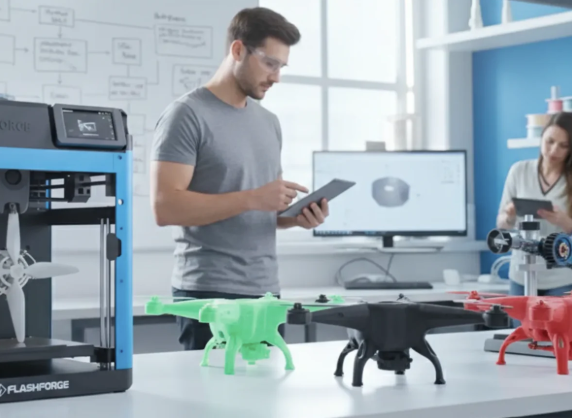
3D printing has emerged as a transformative technology across various sectors. In healthcare, it enables tailored implants and precise surgical models. The manufacturing industry benefits from efficient prototyping and waste reduction. Aerospace engineers leverage lightweight components to improve aircraft performance. Moreover, the realms of fashion and art are witnessing breakthroughs in design possibilities. Each application presents unique challenges and opportunities that warrant further exploration into their implications and future potential.
Transforming Healthcare: 3D Printing in Medicine
As 3D printing technology continues to advance, its potential to transform healthcare becomes increasingly evident.
Innovations in bioprinting organs and tissue engineering facilitate the creation of personalized implants and customized surgical models.
Moreover, advanced medical devices enhance precision in operations, while tailored drug delivery systems improve therapeutic outcomes.
This integration of technology not only empowers patients but also revolutionizes traditional healthcare paradigms.
Revolutionizing Manufacturing: Custom Parts and Prototyping
The advancements in 3D printing technology extend beyond the realm of healthcare, making significant strides in manufacturing processes.
Additive manufacturing enables the creation of custom parts and rapid prototyping, offering unprecedented design freedom.
This innovative approach allows manufacturers to optimize functionality, reduce waste, and accelerate production timelines, ultimately transforming the landscape of industrial design and enhancing the capabilities of modern manufacturing.
The Future of Aerospace: Lightweight Components and Designs
While traditional aerospace design often prioritizes strength over weight, the integration of 3D printing technology is fundamentally shifting this paradigm by enabling the production of lightweight components that do not compromise structural integrity.
This innovation facilitates aerodynamic optimization, allowing for designs that enhance fuel efficiency and performance.
As aerospace engineers embrace this technology, the potential for advanced, efficient aircraft becomes increasingly attainable, revolutionizing the industry.
See also:dailydishnews
Creative Innovations: 3D Printing in Fashion and Art
Although 3D printing has primarily gained recognition in industries such as aerospace and automotive, its impact on fashion and art is equally transformative.
Designers leverage this technology to create intricate wearable technology, merging functionality with aesthetic allure.
Artists utilize 3D printing to explore new dimensions of artistic expression, crafting unique pieces that challenge traditional boundaries and invite personal interpretation, ultimately redefining creativity in contemporary culture.
Conclusion
In summary, 3D printing stands as a monumental force reshaping multiple industries, from healthcare’s personalized solutions to manufacturing’s rapid prototyping capabilities. Its impact extends to aerospace, where lightweight components soar the skies with unparalleled efficiency, and to the realms of fashion and art, where creativity knows no bounds. As this technology continues to evolve, it promises to unleash an avalanche of innovation, transforming the very fabric of production and design into a tapestry of limitless possibilities.